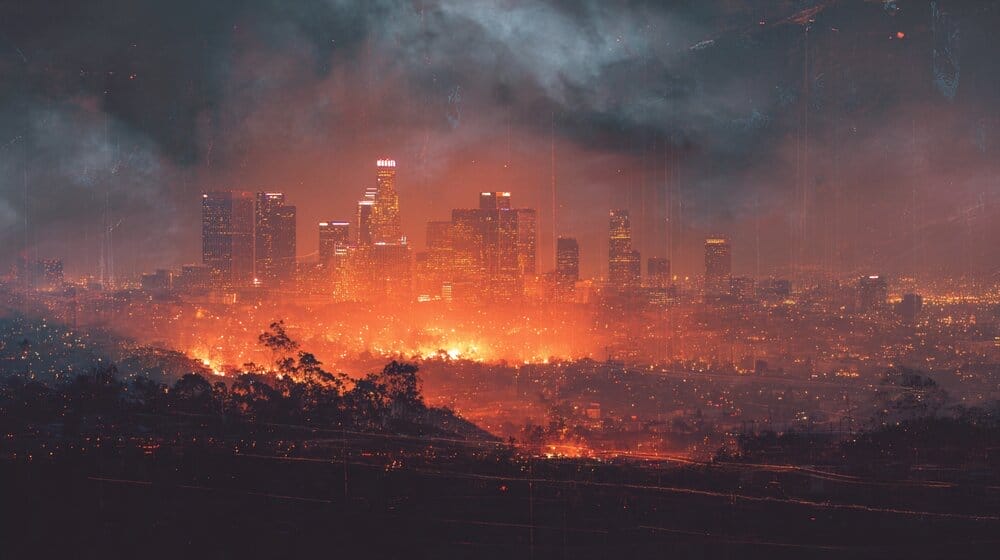
California’s wildfires end up racking up over a billion dollars in expenses annually with the vast majority of that covered by federal taxpayers. The nightmare doesn’t end when the flames die and the bills are paid. Far from it. Survivors face an uphill battle to rebuild. Experts say replacing the 11,000 homes lost in L.A.’s January 2025 wildfires could cost $40 billion and take up to 40 years, if even attempted. Today, we check in on progress and recovery after some other major fires.
The following is a transcript of a report from “Full Measure with Sharyl Attkisson.”
Watch the video by clicking the link at the end of the page.
John Fell is a retired Chico, California fire captain and U.S. Forest Service emergency responder.
John Fell: There’s times when you think about, you know, you come out here, you look around and you go, well, this used to be here.
His own 3,000-square-foot home burned in the July 2024 Park Fire, after embers ignited a neighbor’s house and then his, in a domino effect.
Fell: It gets kind of sad, frustrating. But I look at it this way. We’re fairly fortunate we had, you know, good insurance. And so when I start to feel kind of like, you know, down and out, I kind of realize that it’s not that bad. It could be worse.
The Park Fire is believed to be California’s largest arson fire ever charring nearly 430,000 acres. But since most of it was wilderness, not buildings, it fell below the threshold to qualify for federal help.
Up the road from John Fell’s property is Jonathan Tehan’s family land— also ravaged by the Park Fire.
Sharyl: Are you planning to rebuild something here?
Jonathan Tehan: I would like to, what I’ll do, I don’t even know right now.
Tehan, a volunteer firefighter, describes a chaotic cleanup where free debris removal was promised through local Butte County efforts— but filled with misunderstandings and disappointments.
Tehan: There was just a lot of difficulties that were unnecessary, that should have been addressed early on. A lot of our questions were asked early on that we didn’t get answers till the very end when it was like, ‘You either do it our way or you’re out of the program.’
Today, he says he’s stuck with a mess still left behind and no way to rebuild.
Sharyl: How are you going to get through that and move on?
Tehan: I have to accept it just like everything else. I have to accept it and move on.
California’s five most destructive wildfires between 2017 and 2020 collectively destroyed 22,500 homes. It’s estimated only about 38% have been rebuilt. Homeowners cite problems ranging from insurance shortfalls, to delays getting permits, and high costs.
Perhaps no place illustrates the long road to recovery better than a spot just up the road from where the Park Fire happened: Paradise, California. The whole town was nearly erased six years before by the 2018 Camp Fire. Ignited by the power company PG&E, the Camp Fire raged for 18 days, killing at least 84 people in Paradise. Total damage hit $16.5 billion.
Steve Crowder: We lost about 12,000 homes that day, about 90, 90 to 95% of our entire town.
Mayor Steve Crowder lost his own home and business in the blaze. He went from frantically directing evacuations two days after he was elected, to overseeing the town’s rebuild.
Crowder: Prior to the fire, you could have bought a house, average house for probably 225, 250,000. Now the average home price, probably 450,000.
Recovery has meant dealing with unexpected challenges like squatters moving in and taking over property, and grifters capitalizing on charity.
Crowder: So the fairgrounds were, they were feeding people, they were giving gift certificates for, you know, restaurants, gas, all of this. Our assemblyman went down there and was going around and he determined about 60% of the population of the fairgrounds were not Camp Fire victims. They were people that came from other communities because they were getting free things and shelter and all of that.
Sharyl: Is there a whole subculture of people who move around like that?
Crowder: Apparently there is. And we watched them move in there and just squatted on lots. And it’s tough to get these people out of there. And we’re still fighting that seven years later.
Sharyl: What is the status of rebuilding Paradise?
Crowder: So our housing stock is about 42% of what it was pre-fire. Our population is 11,000 as opposed to 26,500 pre-fire. Building costs in Paradise pre-fire, you could build a house for 150, $175 a square foot. It jumped overnight to $350 a square foot plus, nobody’s houses were insured for that. So that was an issue. This fire was absolutely the perfect storm.
Crowder’s own rebuilt house overlooks a landscape far different than what existed before the Camp Fire.
Crowder: Every one of these lots had houses on them. This area now is just probably within the last year started to recover house wise. All of, all of these houses that you see here are all brand new. None of them. None of them survived.
Not only are houses being rebuilt to stricter fire codes, but PG&E has buried the power lines to reduce the chance they’ll spark another disaster.
Sharyl: As far as you know, has PG&E decided to bury more lines after they started doing so here?
Crowder: They have. They’ve agreed to underground 10,000 miles of lines in fire prone areas, and I know they’re doing that.
Now, a year and a half after his home was destroyed in Chico, John Fell is among those determined to rebuild here.
Fell: We just last week finished pouring the slab and now we’re waiting for it to cure and we’ll start the framing process in about two weeks.
Sharyl: When do you estimate you’ll be back in your house?
Fell: Maybe eight months.
Sharyl (on-camera): California recently announced it is increasing its mortgage relief. The state will now pay up to a year of mortgage payments, up to $100,000 for people whose homes were severely damaged or destroyed in the fires in 2023 or 2024 through January 8th, 2025.
Watch the video here.


Why is it taking so long to stop Medicare snd Medicaid fraud? Why are our tax dollars being stolen and sent to foreign countries? Is everyone in government incompetent at best or at worst part of the problem?
What a grifting mess! It’s nearly everyone taking advantage of an avoidable tragedy – the green grifters included. Government again is the center of the problem and is the vehicle for grift. Despite claims to the contrary, they didn’t care or care to foresee the lives taken by fire, theft, and horrible stress.
Sharyl, you expose the stories that no one else covers but could if they had your integrity and passion. Thank you for another great article.
Lisa,
Sharyl
—and Full Measure Team :
Re : Left-Wing Arsonists Unreported by MSM
Arsonistic
Communists ( those Libertine / Liberal / Leftists )
start fires, then blame utility companies’ electric lines.
Helena Glass, regarding Arsonists around the globe :
https://helenaglass.substack.com/p/arson-across-the-globe-a-for-profit?utm_source=substack&utm_medium=email
-Rick