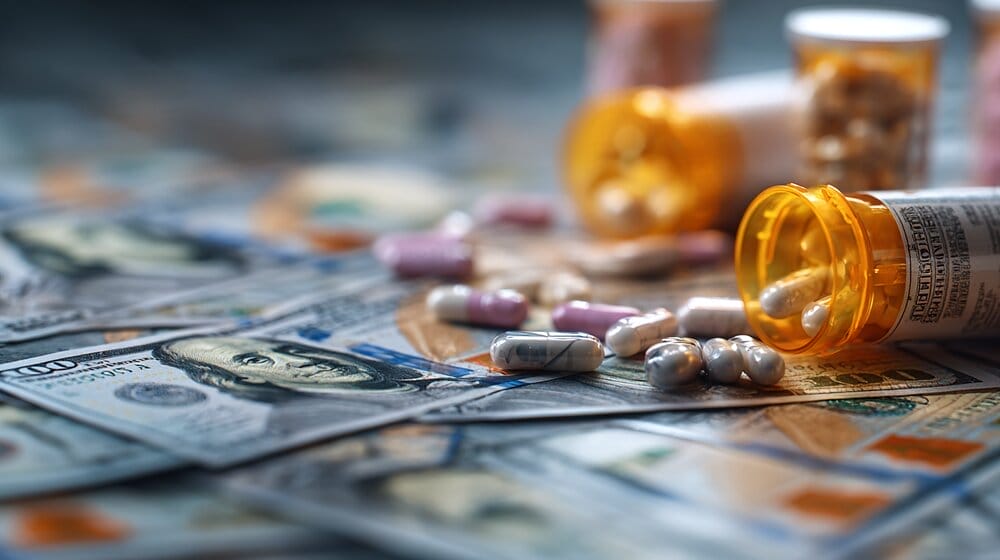
Sixteen years after the Affordable Care Act or Obamacare became law prescription drug prices remain one of the most baffling and infuriating parts of healthcare for everyday Americans. Expanding insurance promised affordability, but instead it supercharged costs. Today, we pull back the curtain on the hidden system of inflated list prices, and discount games that often leave us paying way more. And look at eye-opening solutions.
The following is a transcript of a report from “Full Measure with Sharyl Attkisson.”
Watch the video by clicking the link at the end of the page.
Here at Forest Park Pharmacy in Fort Worth, Texas owners Brad and Glenda Hart don’t take insurance. And for some customers, it means they save— big.
Robert Bailey/Customer: I’m always pleasantly surprised. I had a $309 prescription at CVS and just before I picked it up, I called here. It cost me $42.
Chris Hamilton/Customer: I save a couple hundred dollars every time I fill this medication here versus going to the pharmacy, the big national pharmacy down the street.
Sixteen years after the Affordable Care Act, or Obamacare, more people are looking for better alternatives to pay for medicine.
Brad Hart: What makes us different is that we don’t accept insurance. We just charge the price of the medication. We mark it up 15% and then we charge a $10 fee. And that’s the price that patients pay. And that allows us to be really unique from a pricing perspective and from an availability perspective for patients.
Never have prescription drugs been more expensive, and the system to pay for them— more complicated. Ironically, all of that is tied to insurance. “Obamacare” got millions more people on insurance. But instead of lower prices through competition, insurers negotiate hidden deals, controlling which drugs you can and can’t access, providing bigger profits for the companies while you pay more.
Jack Hoadley, is an expert on the topic, and research professor emeritus at Georgetown University.
Jack Hoadley: We’ve really developed this kind of crazy system where the list prices of drugs are very artificial concepts and not something that really anybody pays.
In other words, drug makers and insurers raise list prices so they can pretend to give deep discounts. And it makes everything cost more.
Hoadley: In fact, there’s a concept out there in the system called an average wholesale price or an AWP, but sometimes people say it’s an ‘aint what’s paid’ price
Sharyl: Because nobody ever pays it?
Hoadley: It’s artificial. It’s just a number on a piece of paper.
Under today’s system, drug makers set artificially high prices for brand-name drugs: say $100 for a drug that costs $25. Then they give large discounts on the inflated price, rebates paid to your insurer, to get the drug on the preferred list where it’s most likely to be prescribed. It’s an illusion of savings through negotiations, while costs are driven up. Ultimately, your co-pay may be higher, because it’s based on the artificially high list price. And the artificially high list price factors into higher premiums your insurer charges.
The same distortion happens with the biggest purchaser of drugs: Medicare and Medicaid, government insurance for the elderly and poor. Paid for by your tax dollars. Hart points to an extreme example of a cancer drug to show how broken the system is.
Hart: One of the worst drugs is Abiraterone. That drug, Medicare, spends $2,800 per prescription on that drug. At our pharmacy, it’s $63. Now, whatever the patient pays that copay, it could be anything, but on the back end, that price is outrageous. They spend $880 million on that drug every year. At our pharmacy, it would be $860 million cheaper.
It’s not just pharmacies like Forest Park that are providing alternatives. Companies like Good Rx negotiate directly with pharmacies, avoiding the complex insurance system with the fake markups and discounts.
Hoadley: GoodRx provides a way of providing the same kinds of discounts that those insurance companies arrange, but make them available to you as an individual consumer.
GoodRx declined our interview requests, but the company reports saving customers $85 billion since 2011, with 82% average discounts off retail.
With health care costs at a breaking point and patients clamoring for a system-wide fix, President Biden aimed to negotiate “Maximum Fair Prices” for 10 high-cost drugs under Medicare to save billions. However, analysts say drug companies quickly raised their prices on other drugs to make up for having to negotiate on the ten.
Now President Trump has revived an approach he pushed for during his first term called “Most Favored Nation” using tariffs and incentives to convince drugmakers to set U.S. drug prices closer to the lower prices they charge elsewhere.
President Donald Trump (Oct. 10, 2025): You are going to pay whatever the lowest price anywhere in the world is, that’s what you are going to pay.
Hoadley: What TrumpRx is doing is saying, no, we’re gonna get a discount from you a different way. We’re gonna look at the larger international scene of pricing and there are cheaper prices internationally for a lot of complicated reasons. We want you, Eli Lilly or Merck or whoever the manufacturer is to give us something that looks more like the prices you give to Europe, to customers in Europe. And Trump is using the leverage of tariffs and other kinds of tools to try to be that negotiating leverage.
The growing list of companies on board with TrumpRx pricing includes: Pfizer, Eli Lilly, Amgen, GSK, and Merck. TrumpRx.gov will connect patients directly to the discounted prices.
President Trump (February 5): And now you are going to be getting those drugs at numbers not with a one or two or 10 percent discount. But think of it, 80 percent, 90 percent in some cases. Numbers that nobody has even thought possible.
For now, America’s inflated and complex drug pricing system is in transition. Experts advise: shop around. Check your insurance price and co-pay, versus filling the prescription under GoodRx, using an independent pharmacy, or TrumpRx.gov. And even if you’re not buying at Forest Park Pharmacy, you can learn a lot at Forestparkpharmacy.com.
Hart: I think everybody needs to understand the real cost of their medication. They need to know if their insurance company is saving them money or if the insurance company is ripping them off. That’s what our price checker’s for. If you’re somewhere I can’t mail, then you can look around and see who is charging me a better price so that the insurance company isn’t ripping everybody off. So use the price checker, find out what your drugs cost, shop around, and see if we can force the market to solve some of these problems.
Sharyl (on-camera): For more on this story, look for my podcast, Full Measure After Hours.
Watch the video here.


The ACA was never designed to benefit the US citizens. All it accomplished was to hand everyone in the country over to the insurance companies. They disguised it as providing for those who can’t get insurance when in reality we all pay for it.
P.S.
Pope Benedict had explained those
tripped-up priests’ growing weakness
for sexual arousal :
He had reported — “The Sixties Sexual Revolution.”
Today, all boys and men suffer constant
sexual arousal—by extant sexual displays
from among girls/women (( ads, movies,
books, magazines, TV, etc. )).
Lisa,
Sharyl
—and Full Measure Team :
Re : Snake-Oil sales-men/-women, making $-thousand
using the circus-barker ploy of appealing to HOPE
in humans’ psyche
Food is medicine !—while drugs, for the most part !,
are the legacy of 19th-century snake oil salesmen,
capturing small-town folks by using the millennia-
old GRIFT of selling HOPE—for recovery from, say,
old-age and/or disease.
Christian ministers/pastors/CBN-Soothsayers
run that same GRIFT—which it’s how the Roman
Catholic Church became so GAUDY ! / so SHOWY ! /
so RICH with wealth !
Jesus was asked how to pray :
He had replied, “Go into
your closet and commune
with the FATHER—not
‘get into a Mega Church.’
And, so, that GRIFT now includes allowing
pedophile priests to be shuttled here or their,
—away to another parish, after one is caught
diddling children.
-Rick