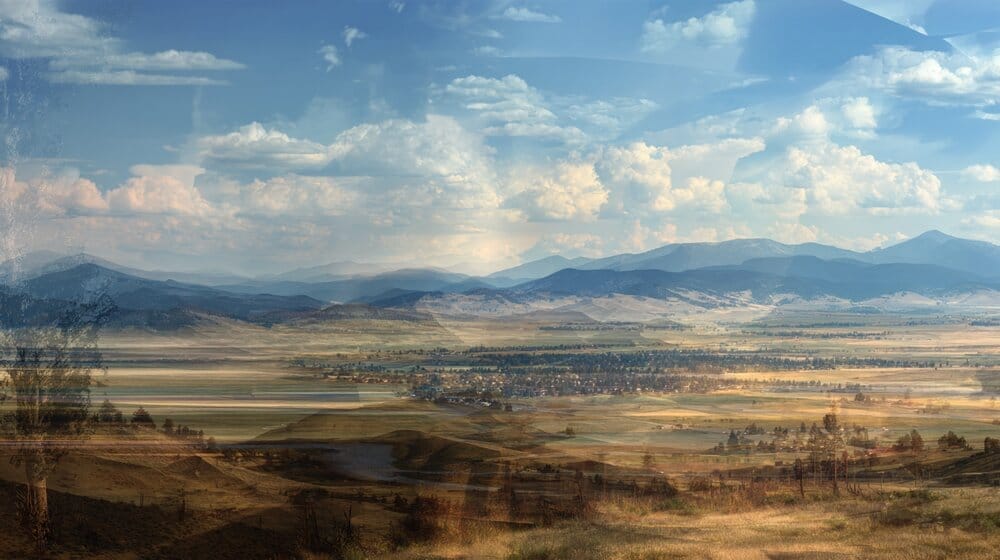
The old expression “There’s gold in them thar hills” is as true today as it was when it was coined during the 1850s Gold Rush. And the price of gold, which has been on a tear for the last five years, is making it profitable again to prospect in areas previously thought to have been mined out. Scott Thuman reports from Montana.
The following is a transcript of a report from “Full Measure with Sharyl Attkisson.”
Watch the video by clicking the link at the end of the page.
Deep in the hills of remote Montana, and hitting the road with geologist and miner Eric Saderholm. We’re on a modern-day hunt for one of the oldest commodities on the planet.
Scott: Is this a target-rich environment out here?
Eric Saderholm: Yes, it is, it has been for a long time, the initial mining started in the late 1850s or 1860s, and that was people who were on their way, the 49ers on their way to the gold rush of California.
Gold has also shaped the history of America, driving western expansion across the land.
In fact, throughout human history, no other natural material has been so desired. The ancient Egyptians called gold “the flesh of the gods,” and today, it remains the definitive symbol of wealth.
While most people have heard that gold prices have been on the rise, you might not realize quite how much. Five years ago, the average price was around $1,800 an ounce. Today, close to $5000 an ounce – a 160% increase. In the US, there are nearly 70 active gold mines, the biggest in Nevada and Alaska.
Scott: Are we in another gold rush?
Eric Saderholm: Yes. I would say this gold rush, but I see this one as more sustainable than the ones in the past. Right now, central banks are pulling in tremendous amounts of gold with no desire to ever sell it. China is purchasing more. India is purchasing more, not for jewelry so much, but to a stockpile just because it’s safe money.
A lot of Saderholm’s work takes place here, as exploration manager for American Pacific Mining, he spends hours studying core samples drilled deep into the ground.
Eric Saderholm: So as you move down to the hole, you get into more and more massive sulfides, but the grades themselves, that’s almost three ounces per ton gold.
Scott: To the layperson, you would have no clue what’s in here, that there’s going to be gold or copper in this rock.
Eric Saderholm: Right. even to the geologists, sometimes it’s so fine-grained. That’s why you send it to an assay lab, and they tell you what you have.
And he shows us where it’s coming from: about four hundred feet into this mine, they’ve found veins of gold they think are going to hit a windfall of the metal, and make it economically viable to make this a site for full-scale production.
But why have prices risen so high, and why now?
Eric Saderholm: I think it’s a realization that most of the money and most of the value associated with current currencies is not valid. It’s not going to hold up. You can only print so many dollars until you realize you’ve diluted the pool so much that they’re just not worth it anymore, and your inflation rates go up, and your purchasing power goes down.
In a day and age where ventures like Bitcoin and even polymarket betting provide opportunities for wealth, gold is still the quote-unquote “gold standard.” But does America have enough of it, especially compared to geopolitical foes like China?
Scott: Are we as a country prioritizing gold enough?
Eric Saderholm: I really don’t think so. Maybe a lot of things are happening secretly; we don’t even know how much gold is in Fort Knox.
Fort Knox in Kentucky is America’s principal bullion depository, guarded around the clock by the US Army. It’s said to contain the bulk of America’s 8133.5 metric tons of gold.
Each metric ton is worth about $107 million at today’s prices, but a full audit hasn’t been done since 1974, prompting calls last year by President Trump for a recount.
President Trump: We do want to look, I mean, we hope everything is fine with Fort Knox, but we’re going to go to Fort Knox and make sure the gold is there. If the gold isn’t there, we’re going to be very upset.
That visit to check on the gold hasn’t happened so far.
China, by contrast, has 2300 metric tons of gold – about one third of what the US has, but many analysts believe the country actually has much more, and it’s been on an aggressive buying spree for years to stockpile gold.
Right above where Saderholm and his team are digging now is a reminder of this area’s rich potential both for gold and what’s often found with it: copper.
Scott: Behind me here is the old Broadway Mine, which was in production from the 1890s till the mid 1940s. During all that time, they pulled out just 144,000 ounces of gold. The hope with the new mine is to pull millions of ounces of gold and billions of pounds of copper.
Further feeding a growing appetite that lately seems to be going more mainstream with every TV ad.
Scott: Why should the average American care about this need for more gold?
Eric Saderholm: So the realization that a true value from thousands of years ago, having gold in your hand, meant something, has come full circle.
If his predictions and prospecting pay off, this could put Montana back on the gold mining map.
For Full Measure, I’m Scott Thuman in Montana.
Watch the video here.


There is an abandoned gold mine in the Bighorn Mountains NW of Sheridan WY. It’s very difficult to find but it might be worth another trip up there on horseback one of these days.